Search This Blog

Friday, January 20, 2017

President Trump can make "America First," but...

Trump should concentrate on the USA first and then the rest of our closest neighbors.

Some have criticized President Trump for saying we must make "America First" in his inauguration speech, that it was akin to supremacist ideology and Nazism. But maybe concentrating on the affairs of countries in our own hemisphere is not such a bad idea after all.

But what would that really entail?

It would have us concentrating more on helping our own country first, perhaps, but also focusing on the international relationships we have with our closest neighbors instead of meddling in the affairs of China, Africa, Europe, Russia, India, Israel, Japan, and the Middle East. I say we should get started with helping our most populace states first, or maybe the poorest one.

Mississippi is the poorest state in the Union. Let's start with building up Mississippi.

Then, let's concentrate on New York City, Los Angeles, Chicago, Dallas-Fort Worth, Houston, Washington, D.C., Philadelphia, Miami, Atlanta, Boston, San Francisco, Phoenix, Riverside-San Bernadino, Detroit, Seattle, Minneapolis-St. Paul, San Diego, Tampa-St. Petersburg, Denver, and St. Louis. Then let's help rural communities. Let's get started here with building America including Puerto Rico.

Next, we need to concentrate on our neighbors to the north and south. Canada, our closest neighbor, should be one of our best partners.

Then there's Central America, consisting of Belize, Guatemala, El Salvador, Honduras, Nicaragua, Costa Rica and Panama.

After that, let's do something about  Mexico, Montserrat, Navassa Island, Panama, Saba, Saint Barthelemy, Saint Kitts and Nevis, Saint Llucia, Saint Martin, Saint Pierre and Miquelon, Saint Vincent and Grenadines, Saint Eustatius, Saint Maarten, Trinidad and Tobago, Turks and Caicos Islands, and the Virgin Islands.

Going further south, we need to have good relationships with Brazil, Columbia, Argentina, Peru, Venezuela, Chile, Ecuador, Bolivia, Paraguay, Uruguay, Guyana, Suriname, French Guiana, and the Falklands Islands.

OK, Trump's State Department and ambassadors. Instead of building empires and warring around the world, let's truly make "America First." 

Any ideas we can use to help?

Thursday, January 19, 2017

Quote for today...

"We're invisible, dangerously invisible, until they want us to sing and dance and be tourist attractions." ---
T'so-ya-ha (Richard Ray Whitman) Yuchi Indian

Obama defines "journalist" in last presidential press conference


"You're not supposed to be sycophants, you're supposed to be skeptics...You're not supposed to be complimentary, but you're supposed to cast a critical eye on folks who hold enormous power and make sure that we are accountable to the people who sent us here." --- President Barack Obama (Photo of Tomi Johnson at work in ATL - by Kurk Johnson)

Monday, January 16, 2017

Father Pfleger indicts clergy, politicians for selling out America's poor

Fox 5 News carried live coverage of MLK celebration
Father Michael Pfleger of the Faith Community of Saint Sabina Church in Chicago was the guest speaker at the MLK Celebration held at Ebenezer Church in downtown Atlanta today. The celebration, which lasted four hours, focused less on Dr. King's legacy of non-violence and more on what we need to do to keep his dream of a beloved community alive.

Pfleger began his remarks by saying, "Shame on you, Mr. Trump," for disrespecting Civil Rights Icon John Lewis (D., Georgia) who represents District 5. "And to do that on MLK's birthday celebration weekend!"  While Pfleger was giving his speech, Martin Luther King, III was meeting with Trump in his New York Plaza Hotel.

The theme of the celebration was "Remember! Celebrate! Act!" In his remarks, Pfleger categorized America as a sick patient in intensive care that can be saved only by citizens becoming peacemakers. He said that we are living in severe, dangerous times, and families are in waiting rooms of fear. "Do you want to get well, America?" he asked the audience. In order to do that, Pfleger said we must stop misappropriating funds for missiles and drones and wage a war on poverty. He said preachers must stop running churches like Fortune 500 companies and dismantle the systems which are killing our children.

"I asked a six year old girl in Chicago what she wanted to be when she grew up, and she said, 'Alive.' Racism is in our blood...we need a blood transfusion," he said. "We must not just take down the Confederate flag but also take down the spirit behind the Confederate flag."

For more information on this subject, go to: http://www.fox5atlanta.com/news/229091054-story

Orthodox Christian's mission to save humanity


Interview with Archbishop Makarios of Kenya

 “Our mission is to save humanity.” --- Archbishop Makarios

Archbishop Makarios of Kenya first visited the U.S. in 1971 when he went to Boston while a seminarian living in Paris. He was attending an international youth conference.  In 2017, he has returned to the U.S., to Metro Atlanta, to attend an international meeting of the World Conference of Churches focused on missions and evangelism. The meeting will involve planning an event that will take place in Tanzania in March 2018 which will be interdenominational, with 1,000 people from all over the world attending. Previous meetings have been held in Tanzania, South Africa, and Switzerland.

This interview just so happened to be done on what would have been the Rev. Dr. Martin Luther King, Jr.’s 88th birthday. Makarios says he often quotes from MLK’s “I Have a Dream” speech.  He will be attending the MLK service tomorrow at Ebenezer Baptist Church in Atlanta. Members of his group have also toured the Museum for Civil and Human Rights as part of their visit.

When asked to contrast the Ethiopian orthodox mindset with the Kenyan orthodox mindset, Makarios says there are a lot of differences. “They call themselves Ethiopian Orthodox Church, but they are not orthodox. The same with the Coptic church in Egypt. They were both actually introducing a kind of heresy because they were saying up to now, that Jesus Christ has only one nature. With us, we say Jesus has two natures – the human and the divine. From the 5th century, they separated themselves. They ran away from us and formed their own church.”

On the question of why churches are so segregated racially, Makarios says he doesn’t see it that way and has a different opinion. “I am dealing only with the African people. I have been evangelizing for the last 40 years and am dealing only with Africans. I am the only European. In our school, we have only Africans from all over Africa. I feel that we need to somehow make it known to the people that it is not the correct thing to think that Europeans are actually racists.”

When asked about the appeal Africans have toward orthodoxy, Makarios said, “It is very important for us to bring the message of the gospel to the African people. Orthodoxy is very close to the African cultures. Me, personally, I have great respect and honor for the African cultures. That’s why I fully participate in their cultural festivals and activities where I am always present. I don’t want the African people to feel that becoming orthodox will make them lose their identity, roots, culture and origins. I encourage them to keep their cultures, and the way I am encouraging them is by translating all the information on orthodoxy into their local dialects. We have students from different African nations, and because of our work on translations, they are celebrating services in their local dialects. Even the Greeks, if we lose our language, then we will lose our identity. I insist that we must translate the church services into the local dialects of the people. By keeping their language, they will also keep their culture.”

 Archbishop Makarios with priests at Holy Transfiguration Greek Orthodox Church, Marietta, Ga.

When asked about challenges orthodoxy faces with the onslaught of Islam, Makarios says having direct dialogue with Islamic leaders is very important. “I cannot say that we have direct problems with Islam.  I myself am very close with the Islamic people. I have many friends.”

He recently traveled to Iran to meet with Muslim leaders. “Not all Islamic people are against the Christians. Not all Muslim people are killing the people.” Makarios said last week he was traveling in a very dangerous part of Kenya, an area where much conflict between Muslims and Christians transpired resulting in assassinations, an area that is still very sensitive, where you need a lot of security to reach your destination, where a majority of the population are Muslims.

“I decided to go, of course with an escort, the police and the army.” Makarios said. “It was two days’ journey from Nairobi. Unfortunately, as we were passing through the forest, the jungle, one of our cars broke down. We were in the middle of nowhere. It was dangerous. Even the Muslims themselves were fearing.” Makarios said he was praying. Muslims helped them, and they were able to reach their destination safely.

Makarios gave us a brief history of orthodoxy in Kenya. “Orthodoxy is connected very much with the struggle for independence of the country. Kenya was like Cyprus, like my country, under the British administration, under colonialism. The Kenyan people were fighting for their liberation. We can go back to the 1930’s, but unfortunately, you see, all the missionaries, the Roman Catholics and Protestants, were under the influence of colonial rule, which meant that in their schools and churches, they were promoting colonialism. A group of people wanted to introduce schools which were independent and not under the control of the colonial people. That group of people were the future leaders of the orthodox church. They were able to establish independent schools in Kenya. They were the founders for the liberation of Kenya."

Makarios said that liberation starts with education. “We have the best schools in Kenya because those schools are not colonial-minded. They were only for education and the free will of the people and also religion. The religion which they have chosen is orthodoxy.

“Those churches were not fighting the Africans. So, when the British discovered that, they closed all the schools which were favoring independence and orthodoxy. So, the leaders of those independent schools were arrested by the British colonial administration. And they were imprisoned in jails. So, there was no activity between 1952 up to 1963. It was only after their independence in 1963 that these people came out from the prisons.” Makarios said the independent movement was led by Jomo Kenyatta. 

Archbishop Makarios of Kenya is also dean of the Orthodox Patriarchal Ecclesiastical School
“Now there is freedom in the country, so Orthodox Christians are able to exercise their religion freely, to establish their schools, their churches, and slowly by slowly, one African bishop was consecrated. Today we have five African bishops.”

Speaking of Archbishop Iakovos who marched in Selma with MLK but was later reported to have been ousted from his leadership role by Bartholomew I for his political views, Makarios said that Iakovos was with King and believed in his movement. When asked about advocacy of the church in the 1960’s being more vocal than today as far as fighting for human/civil rights, Makarios said he was not sure about that. 

Archbishop Iakovos (l) marched with MLK and was featured on Orthodox magazine cover.
“The fact is that the American Orthodox are the people who are supporting the mission in Africa. There is an Orthodox Christian Mission Center in Florida, and we receive assistance from there to promote orthodoxy among the Africans on the African continent.”

Books and CDs can be purchased by contacting the Archbishop at P. O. Box 46119, Nairobi, Kenya or emailing him at Makarios_africa@yahoo.com.

As far as what the Catholics are doing in Kenya, Makarios said, “Of course they have been there for many centuries, but they have not done much. The people knew they were after colonialism. They were not supporting the cultures of the people. They were interfering, they were condemning. You know, Africans are very sensitive. They like their cultures. We honor, support and follow their cultures. We have nothing against their cultures."

Philosophically, when asked about the beginning of the bible, with God separating the darkness from the light, metaphorically what that could connote about separation of the races, Makarios replied that really didn’t have anything to do with race. “If you go through the bible, you will find that God created according to his image and likeness which means that we, the human being, we can really become like Him, like God, any kind of human creation. That is why, when I see you… you know when I met with a Muslim leader, he said to me, ‘This is the first time I am meeting with a Christian leader. How do you see me? I am Muslim, you are a Christian.’ There was no reason for me to think too much about it. And I told him immediately, ‘You know, you are in the image of God. You are a human being. God created all human beings according to His image which means that each and every human being is an icon of God.’ Very simple.”

Makarios says his mission is salvation. “This is my truth. This is why I am dealing with the Africans, because I see them as the images of God. I cannot reject them. I cannot tell them that because you are Africans, you are not like me. We are exactly the same. African, Europeans, Indians, Japanese, whatever – they will be judged equally when the time of judgment comes, we will all be judged equally.”

Makarios is a firm believer, and his countenance speaks to his beliefs. He just doesn’t talk to impress people. When asked about the mission of Orthodox Christians, Makarios said, “To save humanity. Our message is a message of salvation. To bring the people to Christ. If you know Christ, then you will be able to think more philosophically and realize that, yes, there is somebody, somewhere, if I follow Him, and if I become like Him, then there is also for me a space, a place in Heaven.”


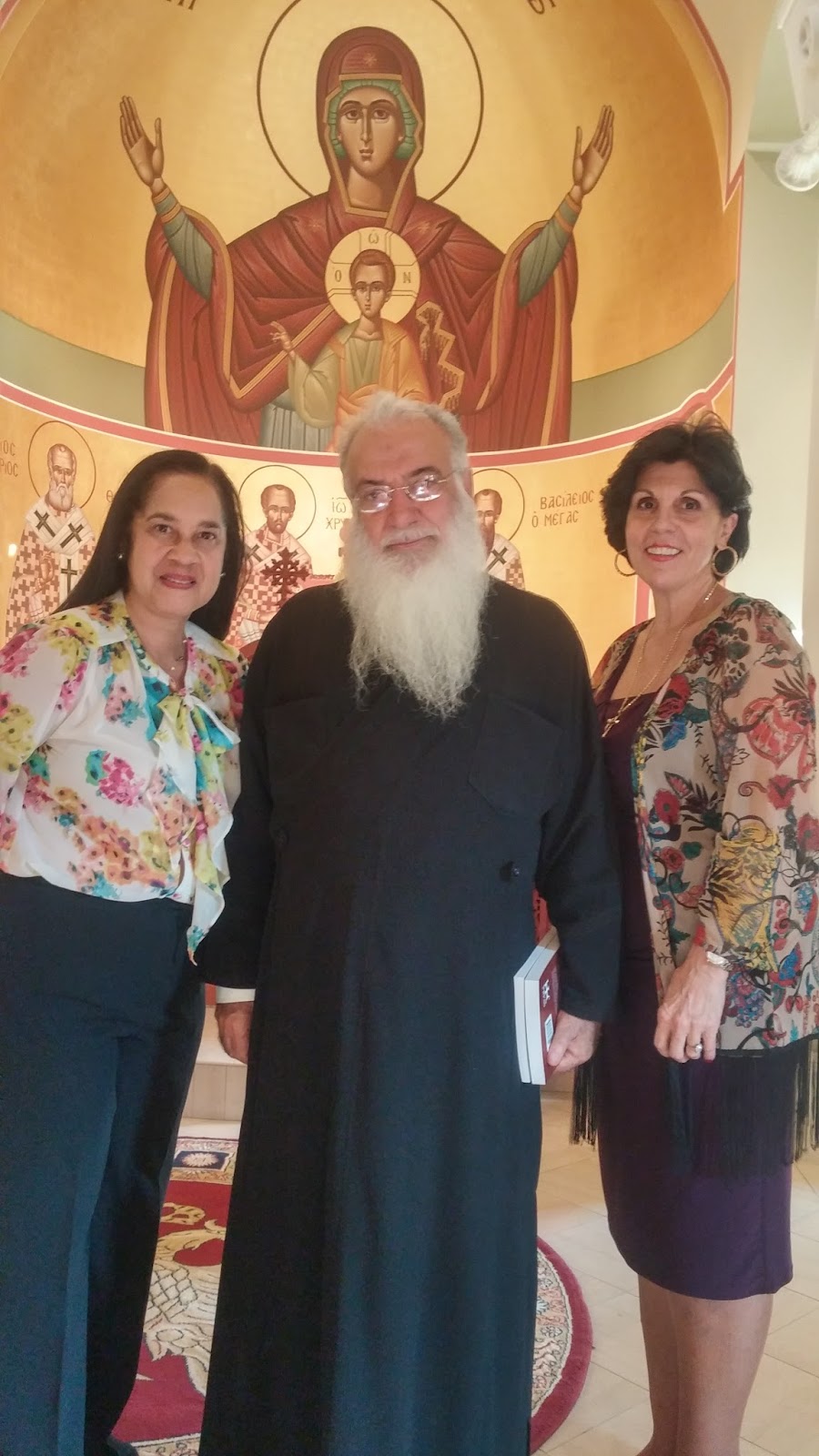
Archbishop Makarios with Tomi Johnson and Maria Caras. (This interview took place on January 15, 2017 at Holy Transfiguration Greek Orthodox Church, Marietta, Ga.)

Interviewer's Note added 1/19/2017: This interview may be deemed more of a respectful public relations piece. Questions still may arise concerning attempts to paint religious missions in Africa as methods to "save" ancient cultures by Europeans who want to "civilize" others and exploit their cultures for their own ends. 

Hopefully this journalist will be able to travel to an African mission to see first hand how the religious community is helping natives there.

In this direction to understand more, read the following:
  

Saturday, January 14, 2017

MLK's legacy depends on his follower's actions and connections to others

Political parody T shirts by Amit Shimoni, Touch of Modern


According to Former Atlanta Mayor Shirley Franklin, keynote speaker at the 19th Annual Martin Luther King, Jr. Unity Breakfast in Canton, Ga., MLK was a strategist with an agenda, and it was not all about dreaming. And it wasn't all about him. Humble, determined MLK bid followers to make "The Promised Land" real.  

It takes action by King's disciples to make his legacy live.

Like Jesus, King convinced others they could do the work whether he was around or not. And that's just what happened, Franklin said. Courage coupled with conviction and coalition building were keys to civil rights movement success. But the fight continues.


Everyone must be all in when fighting poverty, hunger, war, terrorism, generational hatred, and injustice, Franklin said in keynote speech in Canton, Ga.
"Unity amidst division is ours to solve,"  Shirley Franklin
MLK's last public words were, "And I'm happy, tonight. I'm not worried about anything. I'm not fearing any man. Mine eyes have seen the glory of the coming of the Lord."

According to Jesse Jackson, King's last words on the balcony of the Lorraine Hotel were to musician Ben Branch, who was scheduled to perform that night at an event King was attending. "Ben, make sure you play 'Take My Hand, Precious Lord' in the meeting tonight. Play it real pretty." (http://nhdexample1.weebly.com/assassination.html) Take a few minutes to ponder what King was last thinking about before he was silenced by a bullet.

"Inspiring Unity Amidst Division"
"Take My Hand, Precious Lord"  
by Rev. Thomas A. Dorsey (1899–1993)
 
Precious Lord, take my hand.
Lead me on, let me stand
I'm tired, I'm weak, I'm lone
Through the storm, through the night
Lead me on to the light
Take my hand precious Lord, lead me home

When my way grows drear precious Lord linger near
When my life is almost gone
Hear my cry, hear my call, hold my hand lest I fall
Take my hand precious Lord, lead me home

 When the darkness appears and the night draws near
And the day is past and gone
At the river I stand, guide my feet, hold my hand
Take my hand precious Lord, lead me home

Precious Lord, take my hand
Lead me on, let me stand
I'm tired, I'm weak, Lord I'm worn
Through the storm, through the night
Lead me on to the light
Take my hand precious Lord, lead me home

Friday, January 13, 2017

Local events on MLK's Birthday Weekend


 Shirley Franklin was in Washington for Martin Luther King Jr.'s "I ...

Happy, happy birthday, MLK.

Here's what's happening near me. What's happening near you?

Saturday, January 14 at 9:00 a.m., Northside Hospital-Cherokee Conference Center, 1130 Bluffs Parkway, Canton, Ga., 19th Annual MLK Unity Breakfast sponsored by MLK Unity Breakfast Committee In Partnership with Cherokee County and Allen Temple AME Church. Keynote speaker - Former Mayor of Atlanta Shirley Franklin. Guest host - Chesley McNeil, Channel 11 Meteorologist. Free breakfast and parking provided.


Sunday, January 15 at 10:00 a.m., the Archbishop Makarios of Kenya will be the chief celebrant of the Divine Liturgy at Holy Transfiguration Greek Orthodox Church in Marietta, Ga. at 3431 Trickum Road NE.

Archbishop Makarios of Kenya was born in Cyprus but has been serving the Orthodox Church in Africa for over 40 years. He organized and established the Theological School and Seminary in Nairobi, Kenya, under the directive and support of Archbishop Makarios of Cyprus, for the training of the African Orthodox Clergy, starting in 1977.

Archbishop Makarios is a renowned Orthodox Theologian who received a Doctorate from Oxford University in 1976 under the direction of Bishop Kallistos Ware and speaks several languages, including several African dialects.

To offer support to the Orthodox Seminary in Nairobi, a second tray will be passed on Sunday at the end of the Divine Liturgy for the furthering of the work of God and the Orthodox Faith in Africa. Attendees will have an opportunity to meet Archbishop Makarios and receive his blessing at the end of the Divine Liturgy.

Wednesday, January 4, 2017

Who speaks for Black America?

YOU DO!
You Should!
You Must!

We can't wait for MLK, Malcolm, or Jesus to speak. Obama's heading out, and Oprah is on her OWN network which I seldom watch.

The NAACP president is in jail, hopefully writing a letter. But we've all got to fight to make sure that all our gains are not eliminated or turned back.

It's up to us to tell folks what we want and see that we get it!

Onward and upward!

Friday, November 11, 2016

Trump may build wall to keep us in!

Walls can isolate nations, keeping undesirables out while retaining citizens so they can’t leave.
Before Japan opened its doors to outsiders, their leaders implemented Sakoku, a closed country period of national isolation. Under penalties of death, nationals were restricted from leaving. This policy was implemented between 1633 and 1639 and officially raised after Commodore Matthew Perry opened trade with Japan in 1866.

During the U.S. Civil War, one of the duties of Confederate troops was to push back slaves from the coastline into the center of the country so they could not escape by water.

Could Trump want to build a wall to keep us in instead of keeping others out? Could his wall serve a double purpose? Before he was elected President, many folks I talked to said they were thinking about leaving the country for either Canada, Europe, or Africa.

Will we be able to get out of here, and where should we go?

Friday, November 4, 2016

US presidential candidates should discuss international issues raised by CIA

While mainstream media and presidential candidates are focusing on emails, sexual assault, immigration, and ISIS, they are ignoring major concerns the United States of America faces internationally dealing with Canada, Columbia, Mexico, Russia, The Bahamas, Cuba, Haiti, and The Democratic Republic of the Congo (DRC).

According to the Central Intelligence Agency, "the U.S. has intensified domestic security measures and is collaborating closely with its neighbors, Canada and Mexico, to monitor and control legal and illegal personnel, transport, and commodities across the international borders; abundant rainfall in recent years along much of the Mexico-US border region has ameliorated periodically strained water-sharing arrangements.

"Canada and the United States dispute how to divide the Beaufort Sea and the status of the Northwest Passage but continue to work cooperatively to survey the Arctic continental shelf."

Columbia still supplies the most illicit drugs to the US, including heroin and cocaine. The US is "the world's largest consumer of cocaine (shipped from Colombia through Mexico and the Caribbean), Colombian heroin, and Mexican heroin and marijuana; major consumer of ecstasy and Mexican methamphetamine; minor consumer of high-quality Southeast Asian heroin; illicit producer of cannabis, marijuana, depressants, stimulants, hallucinogens, and methamphetamine; money-laundering center.

"The US admitted 84,995 refugees during FY2016 including 16,370 (Democratic Republic of the Congo); 12,587 (Syria); 12,347 (Burma); 9,880 (Iraq); 9,020 (Somalia); 5,817 (Bhutan); and 3,750 (Iran).

"The Bahamas and US have not been able to agree on a maritime boundary; US Naval Base at Guantanamo Bay is leased from Cuba and only mutual agreement or US abandonment of the area can terminate the lease; Haiti claims US-administered Navassa Island; US has made no territorial claim in Antarctica (but has reserved the right to do so) and does not recognize the claims of any other states; Marshall Islands claims Wake Island; Tokelau included American Samoa's Swains Island among the islands listed in its 2006 draft constitution.

"1990 Maritime Boundary Agreement in the Bering Sea still awaits Russian Duma ratification."

For more information on the CIA's reporting on the United States, go to: https://www.cia.gov/library/publications/the-world-factbook/geos/us.html

Wednesday, November 2, 2016

Do we deserve a female president?

Let's face it, we've still got a problem with women leaders. Even though we may pray to Mary, the Mother of God (Jesus) to intercede for us, we have a problem with women becoming priests.

Go figure...

It has been eight long years since we almost elected a lipstick-wearing soccer mom vice-president, and now given the chance to elect Hillary Clinton, we're trying to decided if she may be the lesser of two evils when up against a reality TV show host with no government experience put in the position of running the most powerful government on Planet Earth.

Go figure...

If my daughter was old enough, I would write her name in on the ballot. If I had a granddaughter, I could write her name in another 35 years. All I want is for somebody I can trust to get in the White House, but that's asking for too much.

Whatever the case, I'm not looking forward to the next four years.

Too bad my passage on that ship to Mars won't be available.

We're screwed!